
The Final Stand in the Last Moments of My Life Was an Act of Repentance
Candina
—The Christian Maiden of Rome
by Hart
For two hundred years, in the alleys of Rome,
The Christians would secretly meet:
Or they lived in hiding in the Catacombs,
Deep under the city street!
But after two centuries of persecution,
The Church of the Lamb had rest:
For a wiser Caesar, Philip by name,
Sat down on the throne of the West.
From their hidden dens, from the forests and glens,
The Christians cautiously came;
From the Catacombs ‘neath the streets of Rome.
Came those loyal to Jesus’ Name.
Young men and elders and Patriarchs,
Mothers with babes on the breast,
Fathers and daughters and thousands of children,
Came forth when the Church had rest.
In two hundred and forty-eight A.D.,
In the year this story begins,
Rome’s persecution of Christians, at last
Seemed to have come to an end!
In a dingy, old building on a small, narrow street,
In a tumble-down part of the town,
Lived a poor Christian man, his children and wife;
In a room with just four walls ’round.
He worked in the market most of the morning
To earn their rent and their board;
But the rest of the day, he’d witness his faith
And seek lost souls for the Lord!
His daughter, Candina, was sixteen years old,
And though she was slender and fair,
She had no perfume, nor necklace, nor silk,
Nor broach for her long golden hair.
“Would you please take care of the children, my dear?”
Her mother often would say,
“For the baby is fussing, there’s dinner to cook.
And I’m doing the washing today.”
So Candina would play with them, care for their hurts,
And read from father’s great Book
The stories of Jesus, when He was on Earth
While her mother would launder and cook.
But oft when she went to the market on errands,
She’d pause at the shops and she’d sigh,
When the sashes and jewels and Eastern perfumes
Would catch her wandering eye.
She’d stop and look long at the silks on display;
For her own faded dress was plain,
And she’d wish for a looking-glass all her own,
Though she knew it would make her vain.
And hardest of all, as she walked through the plaza,
Was to see the richer girls pass;
Well-dressed and laughing with carefree young men,
With all that a heart could ask!
Then one day, as she paused by the jewellers,
Longing for a bright golden ring,
A voice from behind smoothly exclaimed,
“My, aren’t you a lovely thing!”
She turned in surprise, looked into the eyes
Of a handsome, richly-dressed youth;
“I was right,” he whispered, touching her cheek,
“You’re a fair young blossom, in truth!”
“My name is Eros Centaurius,” he smiled,
“I’m the son of a noble of Rome:
I live in the night when the city is wild,
And I choose wherever I roam!”
With his talk he enticed her yearning young heart,
With his smile he drew her away;
And her thoughts were of nothing but his dark, handsome face
And his riches, day after day!
One day she went to the market to buy,
And she failed to ever come home:
So her father searched for her all the long night,
Through the dark, wicked streets of Rome.
Ah!–But she passed the hours carefree and wild.
And her heart was filled with delight!
–For Eros had captured that beautiful child
And lured her off into the night!
Rome by night!–Dressed in rich Eastern silk,
Hair up in a golden broach:
Bathed in perfume like a flower in bloom,
And off in a clattering coach!
Rome by night!–Full of pagan delight!
Full of wine and laughter and cries;
Drunken parties and pleasure and pagan gods,
Then to bed, too weary to rise.
In the weeks that passed, as her faith slipped away,
Allured by the riches of Rome,
Her parents would kneel and weep in prayer,
“Oh Lord, bring our daughter home!”
Months passed!–And Candina lived in the wealth
Of Centaurius, the handsome young knave;
Lying in luxury, with all that she wanted,
And waited on by a slave.
To the hunt in the morning! To banquets at night!
To the theatre to watch the absurd!
To the Arena to see Gladiators fight!
–Swept up in a pagan world!
Then, in two hundred forty-nine A.D.
Decius came to the throne!
Decius the Devil, Decius the Damned!
–Was now the new Caesar of Rome!
“The Empire is pagan, and pagan shall stay!
To Christians, death I command!
Hunt them! Destroy them! Sweep them away
Blot out the Church of the Lamb!”
“I barely left being a Christian in time,”
Candina thought, and she smiled,
Then called for a slave to do up her hair
And to have her fingernails filed.
“Come! We’re off to a truly splendid sight!”
Laughed Eros, entering the room;
“They’re killing the Christians in public tonight!
You have just an hour to groom!”
Then off they raced to the Coliseum,
And a great swelling crowd was there;
But Candina was silent, and too anxious to hear,
The riotous laughs in the air!
Then suddenly the laughter turned into jeers
As the guards led some Christians by,
Beaten and bloody and shackled with chains;
And Candina let out a cry!
For there, scarcely more than ten feet away
With blood still wet on his cheek
Her father stood! And he met her gaze,
Though it happened too quick to speak!
For a second he stared deep into her eyes,
As deep as a look might go;
And she felt a sickening wave of shame
Through the breadth and the length of her soul!
“Come! We’ll be late!” called Eros, oblivious,
As the guards pushed her father away,
“All our friends are waiting up in the stands!
By the gods, what a splendid day!”
Yes, they were all there, all of her friends
That she’d partied with for so long;
And she sat down slowly, silent and stunned
In the midst of the riotous throng.
Then she saw her father walk into the ring
As tall and noble and straight
As if he had come to be crowned a king
–And not to meet his fate!
She hung her head and the tears ran hot,
Staining her painted cheeks,
And a vice of shame so gripped her thoughts
That her lips could scarcely speak!
“Oh look” laughed Eros, “Oh, look, I say!”
He nudged the weeping Candina
“They’re throwing the Christians’ children, as well,
To the lions in the Arena!”
Across the dust of the wide, massive floor
Came a woman, her head held high,
Her children around and a babe that nursed
On her breast, so he wouldn’t cry!
Candina grew pale as she strained to see,
And the blood roared through her heart!
Then she saw at last who the woman was…
And it tore her soul apart!
There stood her mother, her brothers and her sister,
With her father in the tiny band;
Then the lions were loosed!–And a deafening roar
Of cheers broke out from the stand!
But just as the lions circled the group,
Something astonishing occurred!
For up in the stands. and across the arena,
A startling cry was heard.
“I am a Christian!” Candina cried out,
As she bolted from her seat to the ledge
She threw off her shoes and leaped right up,
And stood on the great stone edge!
Centaurius fell back in shock in his seat,
And a hush swept over the crowd!
Then the young Christian maiden tore off her jewels,
Raised them, and cried aloud:
“I am a Christian! And my life and my soul
Belong to the Cause of the Lamb!
I despise these riches, these glittering trinkets,
For they’re only an empty sham!”
“No!” cried Eros, “The maid is but drunk!
She’s drunk! Good Romans, don’t listen!
Look at her decked in her perfume and silk!
You can that she’s not a Christian!”
Then she cast her jewels into the stand,
Removed her earrings and broach:
And cried, as she took the rings from her hand,
“I’d rather have Christ and reproach!”
Then she took her snow-white silken shawl
And, wiping her tear-stained face,
Removed her make-up and scented oils,
Wiping away every trace!
Holding the shawl, she cried to the crowd,
“Here’s the beauty you adore
–The cheap, painted beauty that masks the soul
Of those who seek nothing more
“As for these robes and this soft, silken gown,
All smooth to the touch and fair,
I need them not!” And she took them off
And flung them into the air.
She stood on the edge, high up on the wall,
Just a slip on her slender frame;
And cried to the crowd. “You can have the world!
All I want is the Lamb’s Holy Name!”
As she turned and dropped from the great stone wall
To the arena floor below,
A gasp came out from the crowd in the stands
And the friends that she used to know.
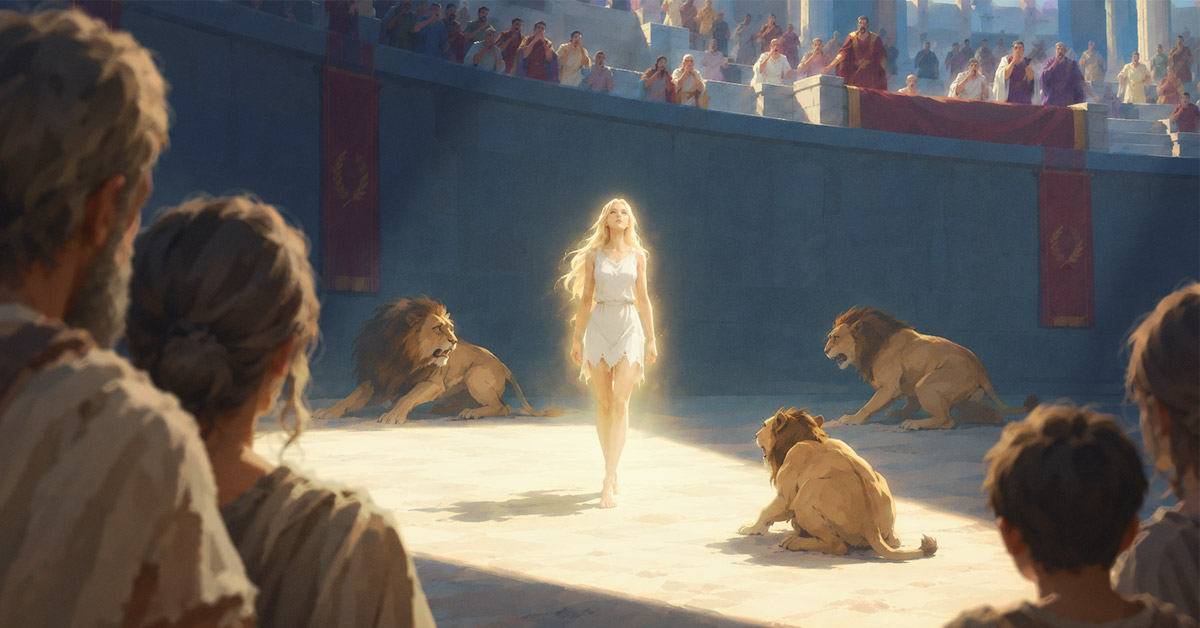
In an aura of earthless beauty and light
That Eros had never seen,
She crossed the Roman ring that night
With the majesty of a queen!
Even the lions, with their bellowing roars,
Stepped fearfully ‘side as she came;
For her face it shone with an Angel’s light
That knew no fear nor shame!
Her father smiled and he held out his hand,
And she met his deep, warm gaze;
“What you taught me,” she said, “is worth dying for!
And I know that this is my place!”
She knelt, hugging her brothers and sisters,
Said, “I’m sorry I left you alone!
I was led astray, like a lamb in the wild,
But now … I am coming home!”
“Mother,” she wept, “I have been so lost,
But I’ve come back home tonight!
Though it’s far less important to die like a martyr,
Than to live the martyr’s life!”
As the lions drew ever nearer to their band,
The Christians burst forth in singing
And it sent such a chill sweeping through the stand,
That for years it’s echo was ringing!
When the lions had done their grisly work,
And the Christians lay still in the dust,
The Romans arose from their seats and left
For home, all silent and hushed.
And many became Christians themselves,
They were moved so deeply inside,
To see the conviction and joy of the martyrs,
And to watch how bravely they died!
O, beloved, remember the name of Candina:
The tale of a Christian girl
Who forsook her faith for pagan pleasure,
Who abandoned her Lord for the world.
And though she came back in the last, trying hour,
And went on to meet her Lord,
Her life was not as it might have been
And she missed the greatest reward!
Does your heart yearn for cheap, worthless trinkets?
Or do you fight for the Cause of the Lamb?
Do you stand with your Family in the arena
Or sit with the world in the stands?
Will you live the life of a martyr now?
Will you lift your voice on high?
For it takes more love to live for the Lamb,
Than it does to bravely die!
Prophecy, Candina Speaking:
I was attracted to what the world had to offer, which was husks and of no value, just as my physical beauty was of no value; it fed my pride, and my pride led me to my downfall. What I went through is what so many throughout history have gone through, yet I was more responsible, for I had known the truth and rejected it. I was as those of the House of David who rejected the truth and returned to the vomit of this world.
My final stand in the last moments of my life was a repentance, an admittance that I had been living a lie. There was born in me a desire to try to make things right. It was a call to all the rich people who were watching to do the same, and some did.
When I entered the spirit world, I was full of shame. I didn’t want to see Jesus. I felt so bad, so unworthy to even be near Him. Yet He appeared before me and took my head in His hands and kissed my forehead and said, “I am proud of you, Candina. You humbled yourself and bared your soul before all your former ‘friends,’ admitting that you had done a terrible thing and that you wanted to change. This had a tremendous impact on them and challenged them to do the same. Raise your head and look at Me.”
I looked into His eyes and saw such love and acceptance that it overwhelmed me, and I thought that my heart would burst. I thought, “How could He love me so after what I had done?” And He spoke to my heart: “You are My love, My darling. I have been waiting for you as a lovesick lover wanting passionately to have you in My arms once again.”
I cried and cried and cried, and He held me in His arms and carried me to His bedchamber as His long-lost bride, and we became one. From that moment on, all I wanted was to be with Him. All the beautiful wonders of Heaven paled in my eyes, as all that mattered to me was Him. I happily gave up self, which I so detested, and became a blue being, (PDF) and I am now right here where I belong, and I am totally and completely satisfied. My story has a happy ending. The happiest!
“Wherefore I say unto thee, her sins, which are many, are forgiven; for she loved much: but to whom little is forgiven, the same loveth little.” Luke 7:47
Submitted by John
(PDF)Prayer Updates – September (PDF)